Loading
Tallahassee's cooling season runs most of the year. If your building's insulation is aging or was installed to outdated standards, you are paying for that gap every month. We install and upgrade commercial insulation with full permitting and code compliance.
Commercial insulation in Tallahassee slows heat transfer through walls, ceilings, and roof decks so your HVAC system runs less and indoor temperatures stay consistent - most single-story commercial projects are completed in one to three days with minimal disruption to building operations.
A significant share of Tallahassee's commercial building stock was constructed in the 1960s through 1980s, before Florida's current energy code existed. Buildings from that era were often insulated to standards that are now considered inadequate for this climate, and many have never been upgraded. In a city where air conditioning runs from May through October, that gap shows up directly on your energy bills. The U.S. Department of Energy estimates that proper insulation and air sealing can reduce commercial heating and cooling costs by 10 to 20 percent in many buildings.
Commercial insulation often works best when it includes spray foam insulation for areas where a tight air seal is as important as thermal resistance. If you have a smaller standalone structure or a mixed-use building with residential space, our team handles both commercial and residential scopes.
If your electricity costs have been climbing steadily but your usage has not changed, aging or failing insulation is one of the first things to check. In Tallahassee, where air conditioning runs from March through November, even a modest drop in insulation performance can add hundreds of dollars per month to your operating costs.
If one area of your building always feels warmer than the rest, or if spaces near the roofline are consistently uncomfortable, heat is getting in where it should not. Tallahassee's intense summer sun bearing down on a flat or low-slope commercial roof is a common culprit when roof or attic insulation has degraded.
Any point where outside air moves freely into your building is a breakdown in the insulation system. Walk your mechanical rooms, attic access points, and exterior wall penetrations. If you can feel moving air or see light around pipes and wiring, conditioned air is escaping and outside heat is coming in.
Tallahassee has a large stock of commercial buildings from the 1970s and 1980s built to energy standards far below what is used today. If your building falls in that range and you have no record of an upgrade, it is worth having a contractor assess what is actually in the walls and ceiling before assuming the insulation is performing adequately.
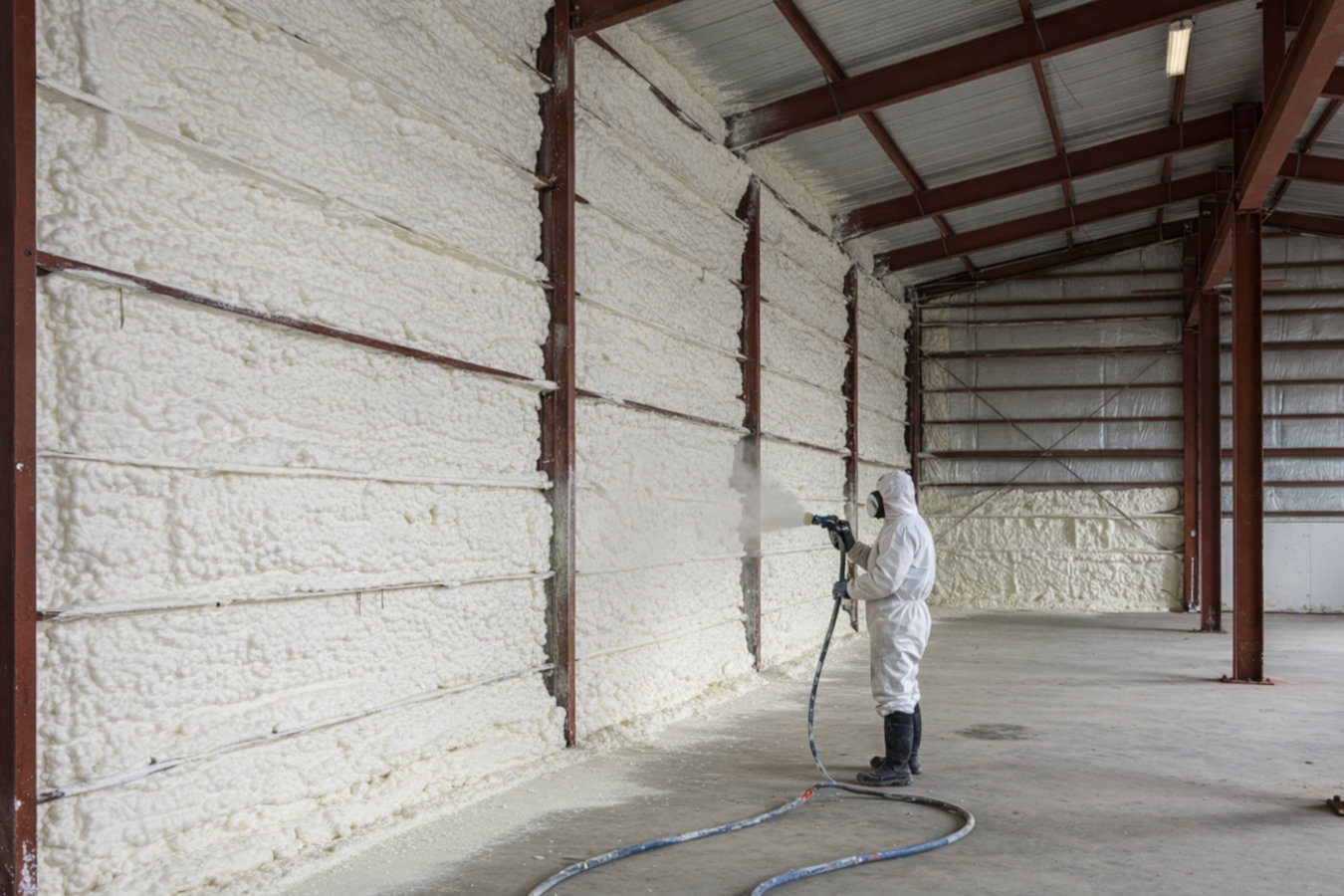
We install and upgrade commercial insulation in offices, retail spaces, warehouses, and mixed-use buildings throughout the Tallahassee metro. For roof decks and flat roofs, we use rigid foam board or spray foam depending on the assembly. For wall cavities and hard-to-reach spaces, we use blown-in material or spray foam insulation that fills gaps and creates a continuous thermal and air barrier.
For buildings with older insulation that has degraded, been wet, or shows signs of pest activity, we remove the old material before installing new. Covering damaged insulation is a shortcut that leads to bigger problems. We also pair commercial insulation with wall insulation services when the building envelope needs attention in multiple areas at once.
All permitted projects are coordinated through Leon County's Building Department. We handle permit applications and inspector scheduling. You receive documentation that the work was completed to Florida energy code requirements, which matters if you ever sell or refinance the building.
Best for roof decks, metal buildings, and spaces where air sealing is as important as thermal resistance.
Best for flat or low-slope roofs and exterior wall assemblies in new construction or major renovation.
Best for attic spaces in existing commercial buildings where access is limited and removal of old material is not required.
Best for buildings with damaged, wet, or pest-compromised insulation that should not be covered over.
Tallahassee experiences some of the most intense heat and humidity in North Florida, with summer temperatures regularly reaching the mid-90s and humidity that makes it feel even hotter. For a commercial building, that means your insulation is working hardest from May through September, and if it is underperforming, you feel it in your energy bills and in hot spots near the ceiling and exterior walls. Tallahassee averages around 55 inches of rain per year, which means moisture management is part of every good insulation decision.
Florida has its own statewide building energy code that sets minimum insulation levels for commercial construction and major renovations. Any permitted insulation project in Tallahassee must meet those minimums, and the Leon County Building Department inspects permitted commercial work. Building owners in Tallahassee and nearby areas like Thomasville, GA and Valdosta, GA face similar code and climate considerations, and working with a contractor who knows those requirements saves you time and protects you from compliance problems down the road.
As the state capital and home to Florida State University and Florida A&M University, Tallahassee has a steady market of office buildings, retail spaces, and mixed-use properties that range from recently built to decades old. The older commercial stock in particular is where we see the most significant energy performance gaps. The Florida Building Commission maintains the current energy code standards that apply to all commercial work in the state.
We ask about your building type, size, and what is prompting the call. You hear back within one business day. We schedule an on-site visit before providing any pricing - a quote given without seeing the building is not reliable.
We walk through the building, look at what is currently in place, identify problem areas, and measure the spaces that need work. We flag anything that needs to be addressed before new insulation goes in and explain what we find in plain terms.
You receive a written estimate with a clear scope of work and total cost. For most commercial projects in Tallahassee, we discuss whether a Leon County permit is required and handle the application ourselves. Permit fees are included in the estimate when applicable.
The crew works in contained areas and cleans up as they go. Most single-story commercial jobs are done in one to three days. If a permit was pulled, a county inspector visits and signs off - we coordinate that scheduling and give you the final documentation.
We walk your property, tell you what we find, and give you a written quote. No pressure, no obligation, and we handle all permit coordination.
(850) 518-3745Every commercial insulation project is completed by an experienced local crew. We pull the required Leon County Building Department permits on your behalf and coordinate inspections so you get a clean paper trail without the administrative burden.
Commercial insulation cannot be priced by phone. We schedule free on-site assessments for every building before providing a written quote. All inquiries receive a response within one business day.
We work throughout the Tallahassee metro and understand the commercial building stock here: the older office and retail spaces from the 1970s and 1980s, the Leon County permit process, and the humidity management challenges specific to this climate.
Florida's statewide energy code sets minimum insulation requirements for commercial buildings. Every permitted project we complete is built to meet those minimums, and the inspection sign-off gives you independent verification, not just our word.
Commercial insulation is not the same as residential work. The permit requirements are different, the materials and methods vary by building type, and the stakes of getting it wrong are higher when your energy costs and code compliance are both on the line. We have been working in the Tallahassee commercial market since 2022 and built a process specifically for this climate and this regulatory environment. Every project is permitted, every quote is written, and every assessment is done in person before any work begins.
Closed-cell and open-cell spray foam for commercial roof decks, wall cavities, and hard-to-reach spaces where other insulation types cannot achieve a complete fill.
Learn moreExterior wall insulation for commercial buildings that reduces heat transfer through the building envelope and lowers the load on your HVAC system.
Learn moreTallahassee's cooling season is long - the sooner your building is properly insulated, the sooner you start reducing energy costs. Call or submit your details and we will reply within one business day.